BlogWeekly refresh
Test widehow to test openings and ideas before you commit spend
6 min read
Coming soonThe Meta Ad Library on the canvas is coming soon.
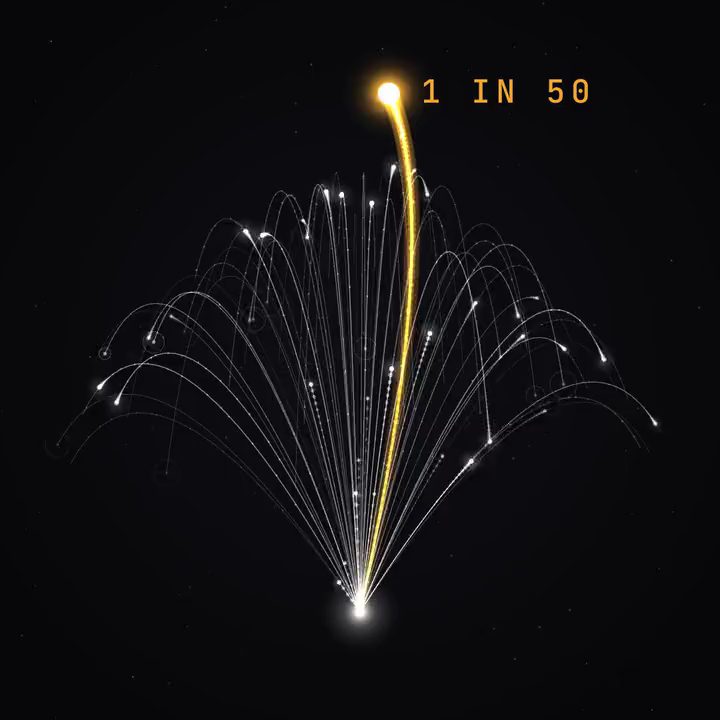
About one tested creative in fifty becomes a winner. That's Superscale's benchmark, and its advice is to put 10–20% of spend into testing to find them (Superscale). At an illustrative 2% win rate, fifty tests produce one winner on average. Running fifty tests takes twenty-five weeks at two a week, or five weeks at ten. That illustrates the effect of testing pace; it is not a forecast for a particular account.
That's the case for testing wide: put many openings and many ideas in front of the market, on ads that are otherwise the same, and let real spend decide. It's the core of the weekly refresh. Here is how to run it.
Test in order: angle, then hook, then format
Practitioners test in a fixed order: the angle first, then the hook on the angle that won, then the format, and never all three at once (Balistro).
Most weekly tests are hooks. The hook is "the largest single driver of whether users see the rest" (Unity). The body and the offer stay, and the first seconds change. For a game that might be a failed level that makes people want to try it, a satisfying sort, a challenge like "Only 1% solve this", a reveal for this week's event, or a real player's hand on the screen, filmed playing the actual game. After the ASA's November rulings, a generated hand or cursor over a scene is a ban risk, because it signals "this is playable". One opening can move a lot: Idle Lumber Empire put AI-made intros in front of its gameplay in August 2025, and monthly installs went from 1.6 million to more than 3.7 million (AppMagic).
An angle test is bigger: a new reason to install, built as a whole ad. Shamanth Rao counts the two separately, because "variant production does not disguise a lack of new ideas" (RocketShip HQ). Both are worth running every week.
Four ways testing breaks
Too few real alternatives. When every opening is an editing job, a team ships a handful a week and fills the gaps with small changes, which Balistro sums up as "12 versions of the same idea with different fonts" that "tests nothing" (Balistro).
Changing more than one thing. If the opening, the music and the end card all differ between two ads, nobody can say which moved the number, so every guide repeats the rule to change one thing at a time. Generated versions make this worse, because asking a model for a new opening redraws the rest of the shot too.
Calling it on too little spend. With small install counts, the winner can be noise (Unity).
Results that don't feed the next test. Untagged assets block learning at the level of the idea, and without a log the same test gets rerun months later. Balistro's blunt summary is that teams blame budget when the real constraint is briefing and approval.
What tools offer for testing
Some tools score an ad before it runs. A score is a guess about the market; the test is the market's answer, and only real spend gives it. Ad generators turn a product page into ten or more ads at once, each a new ad, so they test different ads against each other rather than one opening against another. Layer isolates one element at a time in hook tests and reads network reports so its agent can plan the next batch. Sett's agents read your data, make new concepts and keep their learning inside Sett. Video models with an API can batch out versions, each a new generation, so the parts you meant to keep change along with the part you meant to test. Sovran's hook-demo format tests hooks on a fixed body (Sovran), which is closest to the clean test the guides describe.
A fixed body isolates the creative difference, but delivery still has to be equal. Compare openings under the same campaign conditions: network, market, audience settings, optimization goal and dates. Use the platform's split-testing tools where available; ordinary delivery can give variants different audiences and unequal exposure.
Budgeting and reading the result
There's no universal budget per version, so work it out from your cost per install. Unity's example: at a $2 CPI and 50 installs needed per version, each version needs about $100, split evenly so delivery doesn't pick the winner for you (Unity). Rao's rule for Meta is at least eight ads per ad set and about ten conversions a day per test (RocketShip HQ).
Read the early numbers first. Hook rate, the share of impressions that reach a three-second play, and hold tell you in hours what cost per result takes days to confirm. For games, Unity reads installs per thousand impressions first and then checks what comes later, because an opening can win on installs and lose on return on ad spend if it pulled in players who don't stay (Unity). A strong stop with a weak hold usually means the opening promised something the rest of the ad doesn't deliver.
Scale the winner gradually. RocketShip HQ's rule of thumb is about 20% a day, or 50–100% a week (RocketShip HQ). Put the winner where next week's batch will start from it, and keep the losers on record so nobody pays to run the same test again.
Running a wide test in Motn
Motn's version starts from the ad the team already approved, the body, the offer and the end card, as the control. The opening is one step on the canvas. For each opening idea the team runs that step, gets several takes side by side, the failed level shot three ways, the sort on two different boards, and keeps the best of each. Every opening attaches to the same approved body, so each comes out as a finished ad with every frame after the opening identical, and each goes out in every placement and language the body runs in. Five openings in five placements are 25 finished ads.
Angle tests work the same way, one size up: a new idea built on the canvas from your gameplay and stills as a finished-looking ad, tested before anyone commissions a full production. If it loses, it cost a few generations and its share of the test budget; if it wins, its canvas is the start of the production. Ideas can come from the Meta Ad Library on the same canvas (from the Ad Library to your next brief).
The ad network picks the winner, and Motn doesn't claim to know it in advance. Because everything after the opening is identical, the opening is the only creative difference between versions, so the result can be read as the opening's, within the noise of the test. The winner goes into the shared library to lead next week's batch, and the losers stay in the steps that made them. Beside each tested opening, keep the result and the team's interpretation of it: where it ran, what it was compared with, which metric decided the result, and what to carry into the next brief. For example (illustrative): "Opening B brought cheaper installs but worse day-seven retention. Keep its pacing; don't reuse its reward promise."
Take the ad carrying most of your spend and give it five new openings this week, on the same body, in every placement it runs. Build that first test on your own gameplay with the $10 Try pack, or book a demo and bring the ad.