BlogWeekly refresh
From the Meta Ad Library to your next briefbuilding on what already runs
4 min read
Coming soonThe Meta Ad Library on the canvas is coming soon.
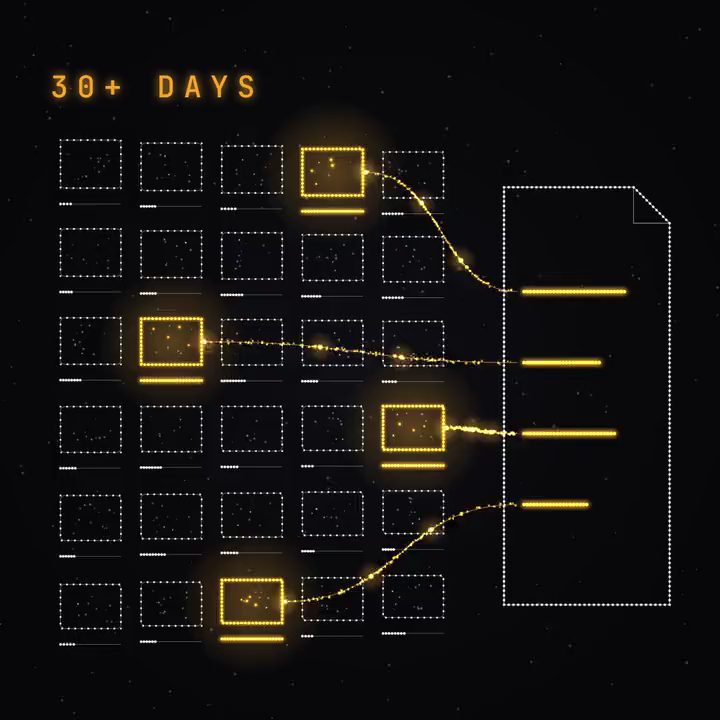
An ad still running in the Meta Ad Library after a month is one somebody keeps paying for. Advertisers switch off ads that don't pay back, so on research day a UA team filters five to ten competitors to ads that have run for 30 days or more and notes the openings, formats and offers that keep coming back (Billo).
That hour is worth spending. Most of its value is lost afterwards. The read leaves the library as screenshots and links, becomes a brief in a doc, and the ads built from it are made in another tool, from a brief that carries the reference but rarely the reasoning. This guide is about keeping the reasoning.
What the library tells you, and what it doesn't
For commercial ads the library shows the creative and the date it started running, with reach only for ads shown in the EU, and no spend or results anywhere (Jon Loomer). Run time is the strongest signal, and even that isn't proof, since small budgets, brand campaigns and forgotten ads also run for months (RocketShip HQ). So weigh it against other signs: one concept running in six versions at once, or the same opening turning up across three competitors.
Where the read gets lost
In the swipe file. The ads go into a Notion page or a Slack thread as screenshots or links, because the library is a live snapshot and paused ads drop out of it. A screenshot keeps the ad but not the reason someone picked it.
In the brief. Turning the file into a brief can be slow: one team Foreplay profiled took about a week to get from idea to brief before it changed its process (Foreplay).
At the handoff. A brief that says "like this one" gets an ad close to the reference, and close copies wear out fast. AppAgent's Alexandra Pulinets estimates that people see your own ad five to seven times but the same idea 20 or more times across competing games (AppAgent). A brief that describes the idea in words loses what can't be written down, such as how fast the first three seconds cut.
Take the reason, leave the execution
Practitioners who study competitor ads give the same advice, and Shamanth Rao of RocketShip HQ sums it up as "take the reason, leave the execution" (RocketShip HQ). AppAgent's examples show what that looks like in games. Royal Match's "Save the King" ads work because the situation suits King Robert, and AFK Journey took a popular format and rebuilt it in its own art style and world (AppAgent). Deciding which reason fits your game takes people who know the game, its characters and the situations they could plausibly end up in.
A routine that keeps the reason:
Pull the three longest-running ads in your category, not the ten newest.
For each, write one line on what to take and one on what to leave, next to the ad, not in a separate doc.
Build from your own footage and art, never from the competitor's frames.
Turn the read into several openings, not one bet. Rao's point is that every idea has to win in your own tests (testing wide).
Keep the read with the ads it led to, so next week's scan is compared with last week's reasoning and results.
What research tools and AI tools do with it
Research tools fix the swipe file. Foreplay, MagicBrief and Atria save ads from the library into shared boards, track competitors and tag openings and formats, and Foreplay and MagicBrief build briefs and storyboards from what's saved; the brief still leaves for production as before, only better organised. AI generators skip the brief: Creatify's Ad Clone takes a competitor's ad and returns a new avatar video with your product in about five minutes (Creatify), and what it keeps is the structure, which every other team cloning the same ad gets back too. Agents read the market on your behalf. Sett's agents work from ad-network, attribution and competitor data and learn inside Sett, and Layer brings "competitive and market context" from Sensor Tower into its workspace (Layer); in neither does the team write down what it took from a competitor next to the ads it led to.
Research day on the canvas
Motn puts the Meta Ad Library on the same canvas the ads are made on, so steps 2 to 5 happen in one place. Say your team runs UA for a merge game. On research day it pulls three competitor ads that have run for 30 days or more onto the canvas, next to its own ads from last week. All three open on a fast board-clearing sequence, and two use a cartoon look that has nothing to do with your game. The team writes its read beside them: keep the pacing, drop the look, use our gameplay.
The batch is built from that read in the same workflow. The steps take this week's gameplay capture from the asset library and the fonts, colours, logo and motion style from the brand library, and the team sets the cuts on the timeline to the pacing it chose. Each step gives several takes side by side, so the team picks the openings that go out. Twelve new ads come out in the game's own brand. The references, the read, the prompts and the chosen takes stay on the canvas, which saves as a workflow for next week's brief. Comparisons with the agent approach are in Motn vs Sett and Motn vs Layer.
Start with next week's research day: pull the three ads in your category that have run the longest, write down what to take from each and what to leave, and build this week's batch from that read with this week's gameplay.